
How Dust Collection and Air Pollution Control Systems Improve Industrial Operations
August 12, 2026
Industrial processes can generate dust, fine particles, fumes, and other airborne contaminants that affect far more than the appearance of a facility. If these materials are not properly controlled, they can interfere with equipment, create uncomfortable working conditions, increase housekeeping demands, and contribute to safety and environmental concerns.
That is why properly designed Dust Collection And Air Pollution Control Systems are an important part of many modern processing operations.
For manufacturers and processing facilities, effective air quality control is not simply about removing visible dust. A well-planned system captures airborne material at or near its source, moves it safely through the facility, separates contaminants from the air, and helps maintain more consistent operating conditions.
Understanding how these systems work can help facility managers determine when an existing system needs improvement or when a new air pollution control solution should be considered.
What Are Dust Collection and Air Pollution Control Systems?
Dust collection and air pollution control systems are engineered systems designed to capture and manage airborne particles created during industrial processes.
Depending on the application, airborne material may be produced during:
- Material conveying
- Crushing and size reduction
- Mixing and blending
- Grinding
- Screening
- Packaging
- Transfer between processing equipment
- Loading and unloading materials
The dust produced by these processes can range from larger visible particles to extremely fine particulate matter that remains suspended in the air.
An industrial dust collection system typically uses strategically positioned capture points, ductwork, fans, filters, separators, or other equipment to remove contaminants from the air stream before the cleaned air is discharged or returned to the facility when appropriate.
Air pollution control systems may also address additional contaminants depending on the process and operational requirements.
Why Industrial Dust Control Matters
Dust can seem like an unavoidable part of material processing, but excessive airborne particulate can cause several operational problems.
A Cleaner and More Manageable Work Environment
One of the most noticeable advantages of effective dust collection is a cleaner facility.
Without sufficient source capture, dust can settle on floors, structural components, machinery, electrical equipment, and production areas. Over time, these deposits can increase the amount of cleaning required and make routine maintenance more difficult.
Capturing material before it spreads throughout the building can help facilities maintain cleaner production areas and reduce unnecessary dust accumulation.
Better Protection for Processing Equipment
Airborne dust does not remain in the air indefinitely. Eventually, it settles somewhere.
Fine particulate material can work its way into motors, bearings, controls, ventilation components, and other machinery. Depending on the material and equipment involved, this contamination may interfere with performance or increase maintenance requirements.
An effective dust control system reduces the amount of uncontrolled particulate circulating through the facility, helping create better operating conditions for valuable processing equipment.
Improved Visibility and Working Conditions
Heavy airborne dust can reduce visibility around production equipment and make certain areas uncomfortable for employees.
Capturing dust directly at transfer points, processing machines, or other sources helps prevent particles from spreading into surrounding work areas. This can support a more organized and controlled industrial environment.
How Industrial Dust Collection Systems Work
Although specific equipment varies between applications, most dust collection systems follow several basic stages.
1. Capturing Dust at the Source
Effective dust management begins with proper capture.
Collection hoods, enclosures, pickup points, or other engineered components are positioned near areas where dust is generated. Capturing contaminants as close to the source as practical is generally more effective than attempting to remove dust after it has dispersed throughout a large space.
The location and design of these capture points can significantly affect overall system performance.
2. Moving Contaminated Air
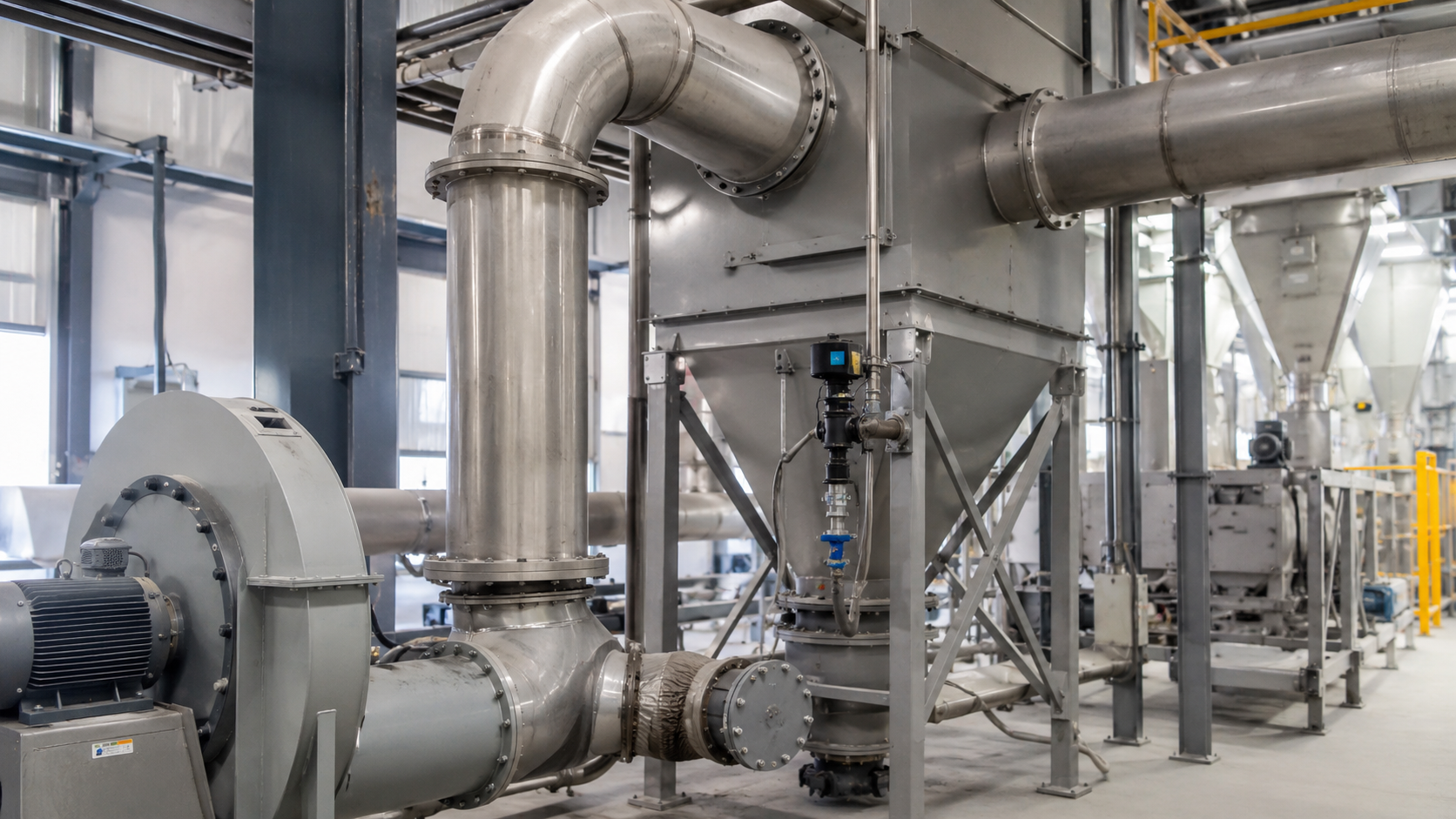
Once captured, the dust-laden air travels through ductwork toward the collection equipment.
Industrial fans create the airflow required to transport particles through the system. Proper airflow is critical. Insufficient air movement may allow material to settle inside ductwork, while an improperly designed system may consume more energy than necessary.
Duct size, routing, pressure requirements, and system resistance all need to be considered during system design.
3. Separating Dust From the Air
After contaminated air reaches the collection equipment, particles must be separated from the air stream.
The appropriate technology depends on factors such as particle characteristics, material volume, process conditions, operating temperature, and filtration requirements.
Systems may use filtration equipment, mechanical separation, or a combination of technologies to achieve the required level of particulate control.
4. Handling Collected Material
Removing particles from the air is only part of the process. Facilities also need a practical method for managing the collected material.
Depending on the application, dust may be deposited into drums, bins, hoppers, conveyors, or another material handling system.
Planning this stage carefully can help reduce unnecessary manual handling and support smoother plant operations.
Every Process Requires a Different Approach
There is no single dust collection configuration that is appropriate for every industrial operation.
The correct system depends heavily on the material being processed and the equipment generating the dust.
Important factors can include:
- Particle size and concentration
- Material characteristics
- Amount of dust generated
- Production volume
- Number of collection points
- Facility layout
- Duct routing
- Required airflow
- Operating temperature
- Existing processing equipment
- Future production plans
For example, a system designed around a small packaging operation may have very different airflow and equipment requirements from one serving multiple material reduction machines or high-volume powder processing equipment.
This is why system planning should begin with an evaluation of the actual process rather than selecting individual components first.
Signs Your Current Dust Collection System May Need Attention
Industrial processes change over time. Production equipment is added, layouts are modified, capacity increases, and different materials may be introduced.
A dust collection system that performed well when it was originally installed may become less effective after these changes.
Common signs that a system should be evaluated include visible dust escaping near equipment, excessive buildup around processing areas, inconsistent suction at collection points, material collecting inside ductwork, or unusually high maintenance requirements.
Facility managers may also notice that dust problems increase when multiple machines operate simultaneously.
These issues do not automatically mean the entire system needs replacement. In some situations, modifications to ductwork, capture points, airflow, filtration equipment, or system controls may provide a more practical solution.
Integrating Air Quality Control With the Processing System
Dust collection works best when it is considered part of the complete process rather than treated as an isolated accessory.
Material handling equipment, processing machinery, ductwork, collection equipment, and facility layout all influence one another.
For example, excessive open areas around a dusty transfer point may require significantly more airflow than a properly designed enclosure. Similarly, changes to processing capacity can affect the volume of airborne material a collection system must handle.
Evaluating the entire process allows engineers and equipment specialists to identify opportunities for more effective source capture and better overall system performance.
This integrated approach is particularly important in facilities that handle powder processing, material reduction, and other operations where airborne particulate can be generated at several stages.
Choosing Equipment for Long-Term Performance
Purchasing dust collection equipment based only on initial specifications may overlook important operational factors.
A system should also be practical to inspect, maintain, clean, and operate over the long term.
Facility managers should consider questions such as:
How accessible are the filters and service components?
Maintenance teams should be able to reach components that require routine inspection or replacement.
Can the system support current production demands?
Airflow and filtration capacity should reflect actual operating conditions, not simply equipment size.
What happens if production expands?
Considering potential future equipment additions can help avoid major system limitations later.
How will collected material be removed?
Dust discharge and material handling methods should fit naturally into the facility's workflow.
Answering these questions during the planning stage can help create a system that remains practical after installation.
Work With Experienced Process Equipment Professionals
Industrial air quality control requires more than choosing a dust collector from a catalog. The collection equipment must work with the material, production process, facility layout, and other processing systems already in place.
Since 1973, R & S Process Equipment Sales, Inc. has provided process industry solutions for customers nationwide. The company's experience includes powder processing, material reduction, air quality control systems, and engineered process equipment solutions.
By looking at the complete operation, experienced process equipment professionals can help identify the equipment and system configuration that best supports production requirements and long-term performance.
Build a More Effective Dust Control Strategy
Dust problems are easier to manage when contaminants are captured at their source and the entire collection system is designed around the actual processing operation.
Whether your facility is planning a new installation, expanding production, or experiencing problems with an existing system, properly engineered Dust Collection And Air Pollution Control Systems can support cleaner working conditions, improved equipment protection, and more controlled industrial processes.
If your operation needs help evaluating dust collection or air pollution control equipment, contact R & S Process Equipment Sales, Inc. to discuss your process requirements and explore a solution designed around your facility.